Budget Travel Tips for First-Time Flyers
Booking your first flight is exciting, and a little nerve-wracking — especially if you're watching every euro or dollar. The good news is that flying affordably isn't about luck or insider secrets. It's a handful of habits around timing, packing, and airport spending that add up to real savings without making the trip any more complicated.
Understanding how airfare pricing works
Before booking, it helps to understand that airfare isn't a fixed number — it moves with demand, season, and how far ahead you're booking. As a rough guide, fares tend to be more favorable when booked somewhat in advance rather than at the last minute, and shoulder-season travel (spring and fall in many regions) is usually cheaper than peak summer or major holiday periods, when demand — and prices — climb.
None of this is an exact science. Prices shift for lots of reasons, and the patterns below are general tendencies, not guarantees.
General timing guidelines
- Domestic flights often price best somewhere in the one-to-three-month range before departure.
- International flights tend to have a wider useful booking window — often a couple of months out to several months ahead.
- Very early morning and late-night departures are frequently cheaper, since demand for those times is lower.
- Major holidays and school breaks push prices up well before the actual date — book those further ahead than you otherwise would.
Money-saving booking strategies
Use flight search tools, but don't stop at one
No single comparison site sees every airline or fare combination, so checking more than one is worth the extra few minutes. If your dates have any flexibility, use a flexible-date or calendar view rather than searching one fixed pair of dates — shifting a flight by even a single day can produce a meaningfully different price. Setting up a fare alert on your route also removes the need to keep checking manually while you decide.
Consider alternative airports
Flying into a smaller or secondary airport near your destination is often noticeably cheaper than flying into the main hub. The trade-off is ground transportation — factor in the added time and cost of getting from a secondary airport into the city center before assuming it's the better deal overall.
Choose budget airlines with your eyes open
Low-cost carriers can offer genuinely good headline fares, but they typically charge separately for checked bags, seat selection, and sometimes even larger carry-ons. Before assuming a budget airline is the cheaper option, add up the total cost with the bags and seat you'll actually need — a full-service carrier's all-in price sometimes ends up close, or even lower.
Packing smart to avoid baggage fees
For a first-time flyer, checked baggage fees can be one of the more surprising costs — they add up fast and can offset whatever you saved on the base fare. A few habits help avoid them entirely:
- Check your airline's specific baggage allowance before you book, since it varies a lot between carriers.
- Invest in a well-fitted carry-on that meets typical size limits, so you can skip checked baggage altogether where possible.
- Weigh your bag at home before you leave, so you're not caught off guard by an overweight fee at the counter.
- Use packing cubes to fit more into the same carry-on space and stay organized.
- Wear your bulkiest items — a jacket, heavy shoes — on the plane instead of packing them, which effectively gives you extra luggage space for free.
Saving money at the airport
Beat airport prices before you get there
Airport restaurants and shops are reliably more expensive than the same items outside security. Buying snacks, drinks, and travel essentials in advance, at regular retail prices, is one of the simplest ways to avoid overpaying on travel day. Many airports now have water bottle refill stations past security, so an empty reusable bottle beats buying water once you're airside. Bringing your own entertainment — a downloaded show, a book, a podcast — also means you're not stuck paying for in-flight WiFi if you'd rather not.
Arrive with enough buffer time
Missing a flight because of traffic or a slow security line costs far more — in money and stress — than arriving a bit early. For a first flight especially, when the airport process is still unfamiliar, build in extra time for check-in, security, and finding your gate. Public transportation or a budget ride-sharing option to the airport is usually cheaper than a last-minute taxi anyway.
A note on travel insurance
It's tempting to skip travel insurance to save money, but it can prevent a much larger loss if your trip gets disrupted. Budget travel doesn't have to mean traveling without any protection — it means being deliberate about which coverage you actually need. Before buying a standalone policy, check what your credit card already includes; many cards offer some baseline trip protection or emergency medical coverage as a built-in benefit, and it may cover some or all of what you were about to pay extra for.
Final thoughts
Your first flight doesn't have to strain your budget. Booking with some flexibility, choosing the right airline for your actual needs, packing to avoid extra fees, and skipping airport markups all add up to a noticeably cheaper trip without sacrificing comfort or safety. None of it requires special expertise — just a little planning ahead and a willingness to stay flexible on the details that matter most.
More in Budget Travel
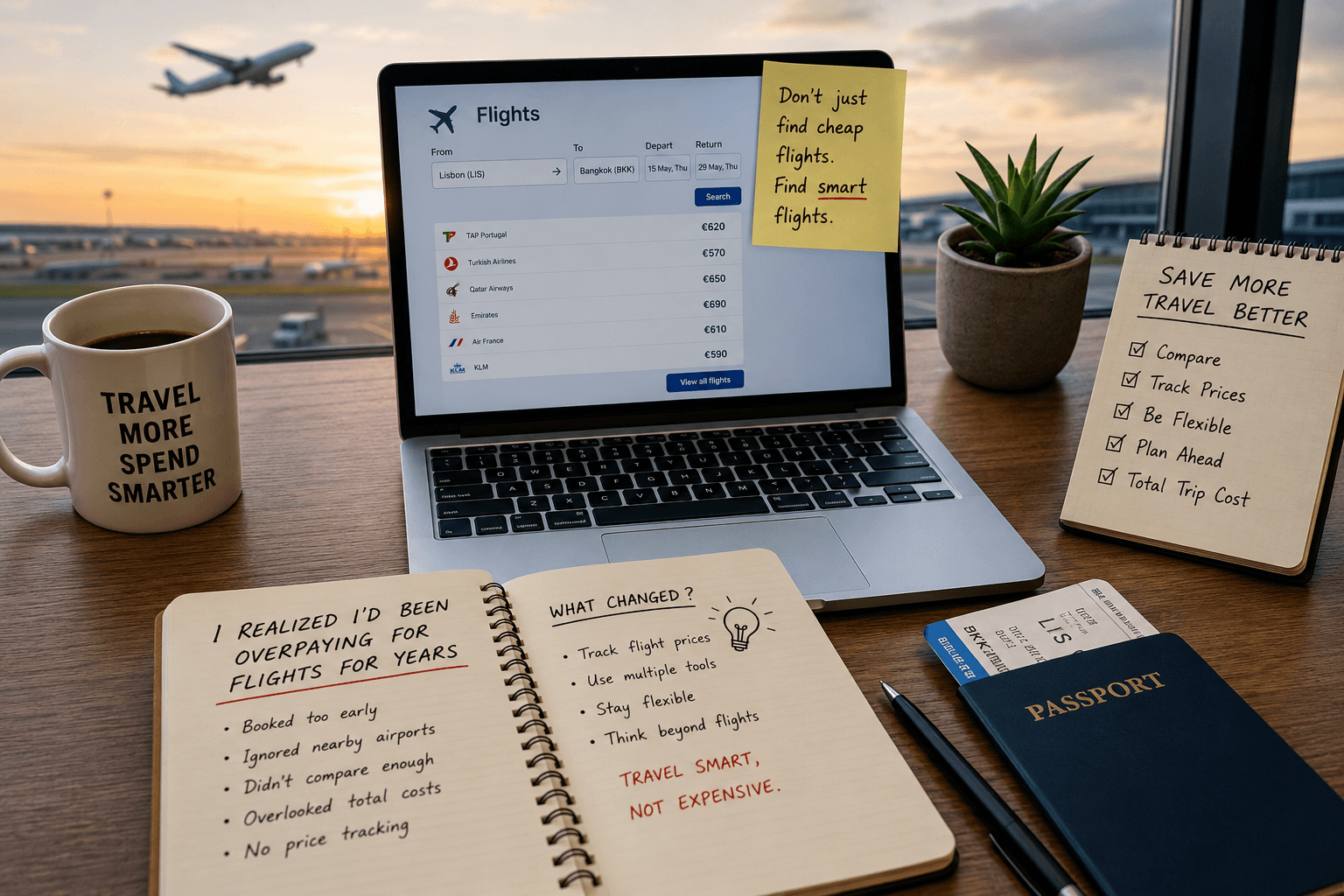
I Realized I'd Been Overpaying for Flights for Years
Booking the first fare that looks reasonable feels efficient. It usually isn't. Here's what actually changes the math when you stop treating flight prices as fixed.
How to Find Cheap Flight Tickets in 2026
Consistently paying less for flights isn't luck. It comes down to understanding fare mechanics, staying flexible, and checking more than one source before booking.
How to Actually Evaluate a Flight Search Tool
A neutral guide to what makes a flight comparison site trustworthy, the tricks to watch for, and how metasearch, OTAs, and airline-direct booking actually differ.